
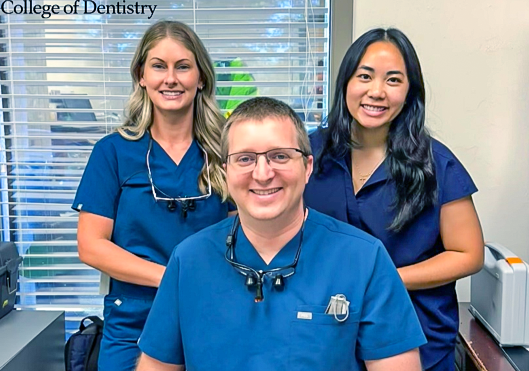
Photo from the University of Florida: (Left to Right) Michelle Cooper, Smallwood, and Mai
What started as a pilot program at the University of Florida (UF) College of Dentistry has evolved into a new way of training the next generation of dentists to confidently care for patients with special needs.
“Being able to build those long-term relationships with somebody I wouldn’t necessarily really meet in everyday life — and being able to impact their life in a really positive way — is probably the most special experience out of this whole program,” says Lauren Mai, a first-year dental student at UF.
Launched in 2024 with the help of a $125,000 CareQuest Institute grant, the College of Dentistry collaborated with the Arc of Alachua County to create a pilot program that provides oral health to adult patients with intellectual and developmental disabilities (IDD). To date, faculty and students in the program have treated 80 patients, with many more still waiting for care.
“As of right now, we have 100 people filling out paperwork to register,” says Bryan Smallwood, DMD, MPH, CPH, clinical assistant professor and dentist at UF.
But expanding access is only one part of the program’s value; it also includes a classroom, bringing the first hands-on experience in special needs dentistry into UF’s dental curriculum. Now, two years later, the pilot has evolved into an elective course, with the potential to become required if administrators can secure an on-campus clinic space.
So far, 35 dental students have completed the program.
“They rotate through our clinic, and they rotate through the OR [operating room] with Dr. Tim Garvey (a UF faculty dentist) they can see the different levels of care that you can provide for adults with special needs,” Smallwood says. “The experience for them is two full days, which is not enough, but it’s way better than nothing.”
Why Many Providers Don’t Accept Special Needs Patients
When the clinic first opened, patients completed intake forms asking about barriers to accessing dental care. One common response surfaced: Many said they couldn’t find a dentist willing to treat them.
Dr. Smallwood says one of his patients had been turned away by 56 providers — not because of complex medical needs, but because she used a wheelchair.
“She couldn’t get out of it, but she could raise up and lean back,” Smallwood says. “And we were able to do all of her treatment right there in her wheelchair. No problem. We didn’t have to do anything extra. She was wonderful. She laughed the whole time. And it was just because she was in a wheelchair that no one would see her. That’s crazy to me.”
Those insights inspired Mai, who is set to graduate in 2029, to dig deeper. She reached out to local providers to better understand why patients with IDD are so often referred elsewhere — or not treated at all. She interviewed 15 general dentists in Florida; 14 said they did not feel prepared after graduating to treat these patients and often lacked a referral network when they were unable to provide care.
“If they did find there’s nothing they can do for a patient in their operatory, who do they refer them to?” Mai says. “Oftentimes, they would just refer them to oral surgery where they have crazy waiting times, or they just don’t have a solution at all.”
Dr. Smallwood says that any dental student or dental professional can learn to work with special needs patients.
“It’s about changing minds — not just hearts, but minds — about what’s possible and making people see that it’s something that you can do every day,” he says. “And it does not take that much extra time to do it.”
Integrating Special Needs Care into the Curriculum
For Mai, the elective course fills a critical gap in dental education.
“We are stuck all the time in a simulation lab,” Mai says. “We have these perfect little patients that we work on all the time. And so, it’s super important for us to get the exposure and to have that different experience because once we get to clinic, every patient is different.”
Mai admits she didn’t fully know what she was signing up for at first.
“I actually applied for an administrative position in community dentistry,” she says. “They never told me it was for special needs dentistry until the day of the interview. I always like new experiences, so I thought it was something that I could do.”
That openness has helped her build strong relationships with patients, including one patient with behavioral disorders who previously struggled during dental visits. She would get upset when dentists would give her anesthetics, so she asked Mai and Dr. Smallwood to talk to her as she was getting treated.
Over time, that approach made a difference.
“Every time she leaves, she seems a little brighter. She seems a little bit happier. She’s sending people pictures, and we talk about her day,” Mai says. “I think the fact that she is coming back and building a really good relationship with us is rewarding.”
Experiences like Mai’s illustrate how exposure and relationship‑building translate into growth — not just for patients, but for students as well. For Dr. Smallwood, that willingness to engage and adapt is exactly what prepares students to succeed.
“When students gain experience treating individuals with conditions such as stroke-related communication challenges, multiple comorbidities, or autism with severe anxiety or repetitive behaviors, they develop clinical flexibility and confidence to manage a wide range of situations,” Dr. Smallwood says. “If you can prepare a student to treat some of our most difficult patients, they can treat anybody.”
What CareQuest Institute Made Possible
Dr. Smallwood says the CareQuest Institute grant — and the connections that came with it — led to UF’s investment in the program. Just as important, it created a pathway for sharing what the team has learned so other schools and organizations don’t have to start from scratch.
“They don’t have to reinvent the wheel and have to figure it out for themselves,” he says. “We want everybody to be successful immediately.”
Smallwood also says the grant created something that’s often missing in clinical training: time.
“Everyone is moving so fast,” he said. “Patients often leave a doctor’s office feeling disappointed after a rushed 15-minute visit. CareQuest gave us the time to slow down, sit with patients, and truly connect, building relationships where both the provider and the patient can grow together.”