
After two states — Utah and Florida — enacted statewide community water fluoridation (CWF) restrictions in 2025, lawmakers across the country introduced anti-fluoridation legislation in several states this year. Despite numerous bills seeking to ban CWF or weaken existing fluoride protections, no additional statewide bans or restrictions on fluoride have been enacted in 2026.
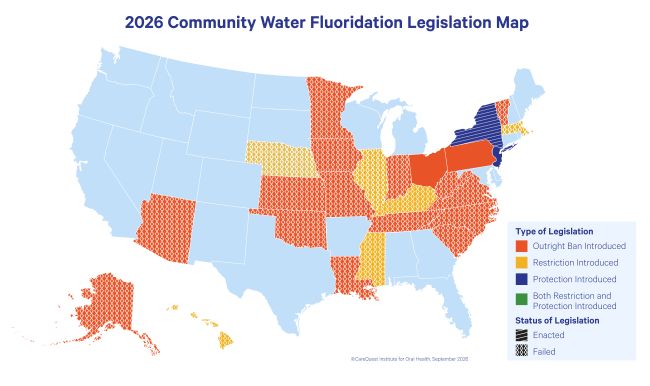
See where fluoridation policy stands in 2026 in your state with our updated interactive map.
At CareQuest Institute, we were encouraged to see lawmakers act in accordance with the thousands of studies demonstrating the safety of CWF and its effectiveness in preventing tooth decay and improving oral health.
Proposed bans or fluoride protection repeals stalled or died during the 2025–2026 legislative cycle in states that include Arizona, Arkansas, Illinois, Iowa, Indiana, Kansas, Mississippi, Missouri, Montana, Nebraska, New Hampshire, North Carolina, North Dakota, South Dakota, Tennessee, Texas, Vermont, Virginia, and West Virginia. Ohio and Pennsylvania’s legislative sessions remain ongoing, and while anti-fluoride legislation has not been formally defeated, it has gained little traction to date.
While there is more work ahead as the debate continues to evolve, the close of this legislative cycle provides an opportunity to step back and consider what this year’s activity can tell us about the broader fluoride policy landscape and lessons for the road ahead.
We Can’t Discount Attacks on Existing Policy
The legislative approaches to CWF generally fell into three categories:
- Outright statewide bans on adding fluoride to public drinking water
- Repeal of existing statewide fluoridation requirements, shifting decisions to local water systems
- Local-option or procedural proposals designed to make it easier for communities to discontinue fluoridation
While most media attention has focused on the statewide fluoride bans, those tracking the policy landscape should not overlook legislation that repeals existing statewide requirements or shifts decision-making to local governments or water systems. This type of legislation appeared in Illinois, Kentucky, and Ohio, among other states. Rather than arguing that every community must immediately cease fluoridation, these bills frame fluoridation as a matter of local control.
Repealing a statewide requirement can produce substantial long-term erosion of fluoridation coverage even without an explicit statewide ban, particularly as local governments face organized campaigns, widespread misinformation, and pressure from anti-fluoridation groups. Local action can also move faster than state legislation. According to the anti-fluoride organization Fluoride Action Network, dozens of communities across the US, serving millions of residents, have taken local action to end, suspend, or prevent fluoridation since late 2024.
Pro-Fluoridation Legislation Can Create Safeguards
 Although there have been fewer legislative efforts to protect CWF, several developments stand out. In 2026, New York enacted legislation establishing procedural protections for communities considering discontinuation of fluoridation. The legislation requires municipalities that want to discontinue community water fluoridation to give residents 90 days’ notice, explain the reason for the proposed removal, and provide an opportunity for public comment. In 2025, Connecticut enacted pro-fluoridation legislation, codifying the recommended 0.7 mg/L fluoride concentration directly into state law. By doing so, Connecticut insulated its state standard from potential changes in federal recommendations.
Other states also pursued targeted protections in 2026, including bills in New Jersey and Hawaii that sought to establish or strengthen state standards governing fluoridation policy and decision-making, but those measures were not enacted.
These efforts reflect a growing recognition that defending existing programs can be more effective than simply defeating repeal legislation. States should increasingly consider statutory protections to insulate established fluoridation programs from changes in federal guidance or efforts to end fluoridation at the local level.
Keeping a Close Eye on the EPA’s Review Process
On August 3, the US Environmental Protection Agency (EPA) released its Protocol for Developing the Fluoride Human Health Toxicity Assessment, advancing the agency’s expedited review of fluoride under the Safe Drinking Water Act (SDWA). This is the next step in an EPA review process that could eventually lead to federal policy restricting fluoride in drinking water.
The new protocol incorporates public feedback received on EPA’s preliminary assessment plan, released in January, and establishes the methodology EPA will use to conduct its forthcoming expedited assessment of fluoride. EPA plans to review evidence on the health impacts of fluoride, but the agency continues to include several studies that use widely discredited methodologies, despite more than 7,000 studies finding that water fluoridation is a safe and effective way to improve health and reduce health care costs.
The outcome of this assessment could drive future changes to federal drinking water regulations and influence state and local debates over fluoridation. Although decisions about whether to fluoridate remain primarily under state and local control, a federal assessment concluding that fluoride poses health risks could strengthen efforts to restrict or discontinue fluoridation programs.
Advocates should closely monitor the forthcoming draft assessment, particularly the agency’s response to public comments identifying weaknesses in the underlying studies. The draft assessment will be subject to public comment before EPA finalizes its findings.
The Continued Fight over Fluoridation
The 2026 state legislative landscape suggests that the fight over fluoridation is not over, and it may increasingly play out at the local level. At the same time, EPA’s forthcoming assessment could add new momentum to these efforts, making it important to track both federal developments and state and local activity while pursuing proactive safeguards for existing fluoridation programs.
Authored by Caroline Le, Public Policy Analyst, CareQuest Institute
Editor’s Note: We invite you to explore CareQuest’s work on fluoride and learn more about the topic in our self-paced course.