
States are bracing for the impact of sweeping federal changes to Medicaid that could affect millions of people, including adults who rely on the insurance for their dental coverage.
In July 2025, legislators signed HR 1 into law, setting in motion steep funding cuts and structural changes that will reshape state Medicaid programs — and affect beneficiaries — for years to come. While many of the law’s provisions are scheduled to begin in 2027, states are already preparing to make difficult decisions as funding tightens.
Tanya Dorf Brunner, the Executive Director of the American Network of Oral Health Coalitions, a CareQuest Institute grantee, says, “States across the county are already seeing the pressure build — and unless policymakers act with clarity and courage, the people who rely on Medicaid for basic oral health are likely to feel the consequences first.”
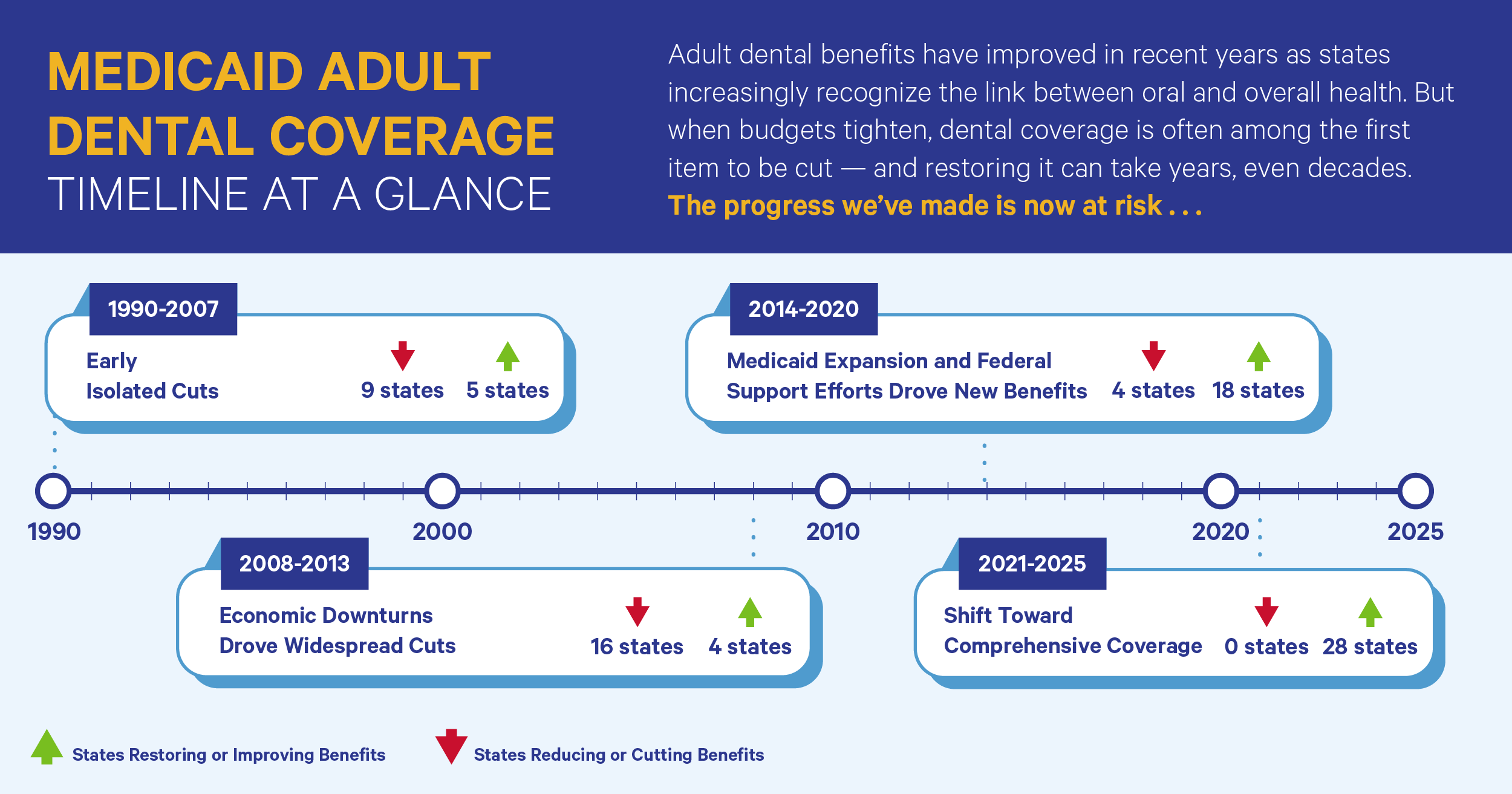 Medicaid adult dental benefits remain optional under the Centers for Medicare and Medicaid Services (CMS) rules, and history shows that optional benefits are often the first to be cut when budgets shrink. When dental coverage is reduced or eliminated, adults lose access to necessary care, leading to pain, worsening health conditions, increased emergency department use, and ultimately higher health care costs.
Unfortunately, the likelihood of that reality is increasing. After several years of progress that improved oral health coverage and access within several states, 2025 and 2026 brought signs of strain: Three states approved or implemented annual benefit maximums (ABMs), and several reduced reimbursement rates.
But there were bright spots, too: Several states, including Connecticut, Kansas, and Maine, increased reimbursement rates. Connecticut received approval to launch the Veterans Dental Program, which will provide $3,000 annually to veterans to cover a wide range of dental services, from routine cleanings and exams to complex restorative care.
Additionally, two states improved their dental benefits for all adults enrolled in Medicaid. And, as reflected in the updated Medicaid Adult Dental Coverage Checker (insert new link when ready), most states saw no change in coverage. The Coverage Checker, which launched in 2022, displays self‑reported data from state Medicaid dental programs, including specific codes and procedures across seven service categories.
In previous years, no change might have been a missed opportunity. But in 2026, it’s a win.
What else can we learn from the Coverage Checker? Here are three insights that are shaping oral health policy as we move into the final months of 2026.
- Some policymakers are reaffirming their commitment to oral health by expanding benefits.
In 2025, Utah strengthened Medicaid dental benefits for all adults, covering services such as exams, X‑rays, cleanings, fillings, crowns, root canals, dentures, and extractions. The state achieved this by taking a step-by-step approach, first extending coverage to adults with disabilities, then people with substance use disorders, then older adults, which demonstrated that broader coverage was feasible. The University of Utah School of Dentistry helped pave the way by covering the state’s share of costs and building a strong network of providers, making statewide adult dental coverage possible.
Nevada followed suit on July 1, 2026, extending benefits to approximately 374,500 adults. Nevada’s benefit improvement was the result of a phased, evidence‑building strategy that began with targeted coverage for pregnant adults and individuals on the Intellectual/Developmental Disabilities (ID/DD) waiver, followed by a legislatively mandated diabetes dental 1115 pilot that further extended dental benefits for people with diabetes served in FQHCs and Tribal Health Centers. These incremental steps, combined with provider network growth, positioned the state to move from historically emergency‑only adult dental coverage to a broader benefit. In May 2026, Nevada received federal approval to extend diagnostic, preventive, periodontal, and restorative dental services (with a $1,000 annual cap) to all adults age 21 and older who are enrolled in Medicaid.
- Some policymakers are protecting coverage despite looming threats.
One of the biggest takeaways from the 2025–2026 Coverage Checker survey cycle? Forty-six states made no changes to their Medicaid adult dental benefits. In a year defined by fiscal pressure and policy uncertainty, holding steady is a meaningful success.
Several states considered reducing Medicaid dental benefits during the 2026 legislative session, and Idaho came closest to eliminating coverage.
The governor proposed $22 million in Medicaid cuts, explicitly naming adult dental benefits as one of the optional services Idaho could eliminate to help address a state budget shortfall. But health officials warned legislators that eliminating preventive dental care would likely increase emergency room visits and long‑term health care costs.
Idaho’s Joint Finance-Appropriations Committee (JFAC) responded decisively: The committee rejected the governor’s plan, voting down motions that would have set the stage for eliminating dental or other Medicaid services. JFAC members called the proposed reductions short‑sighted, noting that assuming Medicaid costs would decrease “threw logic out the window.” Instead, JFAC approved a Medicaid budget that preserved all optional benefits, including adult dental benefits.
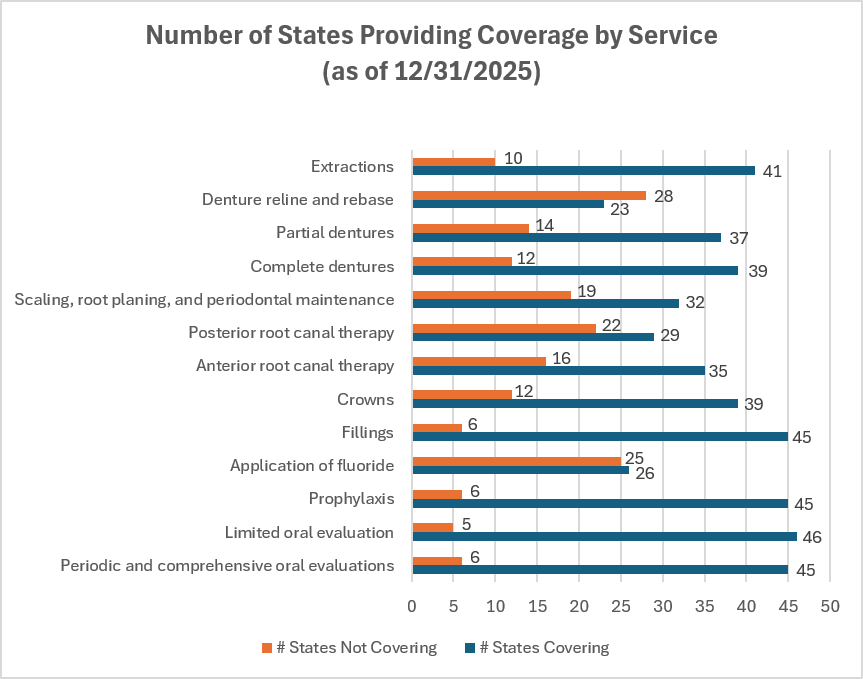
Please note: Several measures assess coverage of multiple CDT codes. A positive response is received only if all listed codes are covered. For instance, in order to be noted as providing coverage of extractions, a state must cover all five extraction codes assessed. Although some states provide coverage of four of the five codes, the response is noted as “no coverage.”
- Signs of potential trouble are ahead.
Although states aren’t eliminating coverage, many are reducing spending — and, in the process, putting more strain on patients’ wallets. Many have started turning to annual benefit maximums (ABMs), the highest total dollar amount Medicaid will pay for a beneficiary’s dental care in a year. While not a direct cut, ABMs can limit access when treatment needs exceed the cap. Patients may delay or forego care, and although exemptions exist in many states, beneficiaries and providers often struggle to navigate them.
In response to budget pressures, three states implemented ABMs on Medicaid adult dental benefits in 2026. As part of cost-cutting measures the previous year, Colorado implemented a $3,000 ABM on July 1, 2026. Massachusetts and Virginia implemented ABMs for the first time, setting limits of $1,750 and $2,000, respectively. Massachusetts’s ABM took effect on August 1, 2026. As of August 25, 2026, Virginia’s ABM has not yet taken effect.
As of August 1, 2026, 17 states have ABMs in place for some or all adult beneficiaries.
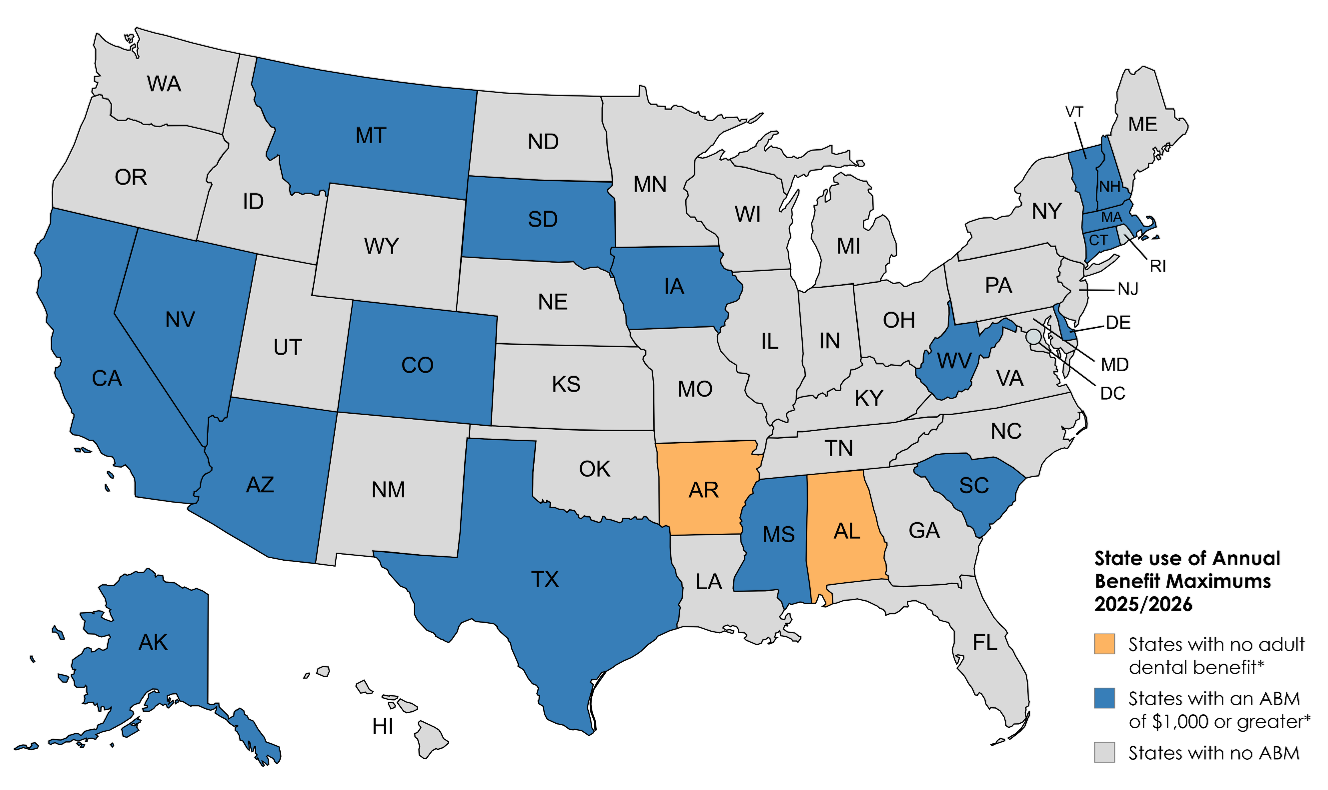
*For the largest group of Categorically Needy Medicaid adults ages 21–64.
Advocates Are Finding New Ways to Strengthen Access
Major challenges loom in 2027: New work reporting requirements will take effect nationwide. State budgets will tighten further as federal funding decreases and new financing limitations begin. Millions of Americans are at risk of losing coverage and going without needed care.
Yet advocates and policymakers continue working to protect and strengthen access. Here are just a few examples of what different states are working on:
- In Connecticut, advocates at Connecticut Oral Health Initiative and legislative champions are pushing for Medicaid coverage of periodontal treatment, twice-annual cleanings and exams, and exemptions for preventive services from the state’s ABM.
- At the Missouri Coalition for Oral Health and Oral Health Kansas, staff members called Dental Medicaid Facilitators, are increasing dentist participation in Medicaid through outreach, media campaigns, and hands-on support with enrollment, credentialing, and billing.

Stacey Auger, MPH
As states prepare to defend hard‑won gains, it’s critical to reiterate a core truth: Oral health is foundational to overall health. When dental coverage is weakened, people lose more than cleanings or fillings; they lose the ability to eat, work, learn, and stay healthy. When policymakers invest in oral health, they strengthen communities, improve health outcomes, and reduce costs across the system.
Authored by Stacey Auger, MPH, Policy Consultant, CareQuest Institute