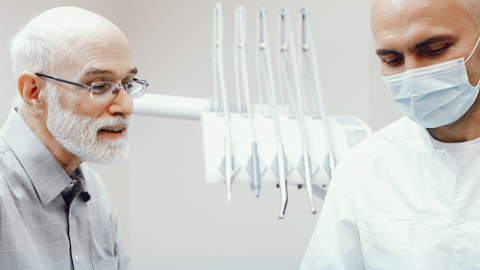
Minimally Invasive Care: An Alternative Approach
Minimally invasive care offers a gentler, more accessible option than standard dental treatment. It prevents and treats decay without removing tooth structure.
What Are the Advantages of Minimally Invasive Care?
The simple treatment options of minimally invasive care can reduce anxiety, cut costs, and improve long-term outcomes. Minimally invasive care can also help patients and providers avoid the repair cycle often seen with other restorative care by finding and treating small cavities early.
Minimally invasive care can be delivered by many members of the care team, including dental hygienists, dental therapists, dental assistants, and medical providers. That can expand access, especially in rural areas.
Types of Minimally Invasive Care
Silver Fluoride
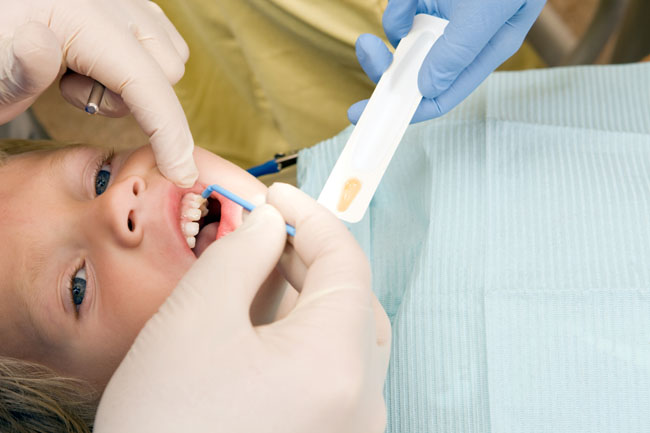
Silver fluoride is a water-based liquid applied to teeth with a small brush. It contains silver, which kills the germs that cause tooth decay, and fluoride, which can help prevent, slow, or stop decay.
Providers often use silver diamine fluoride (SDF) for children, and it can also help adults. It causes less discomfort than the “drill and fill” method, and many people value how easy it is to use. Still, SDF has drawbacks. It can leave a black stain on treated lesions and may burn or stain nearby soft tissue.
Fluoride Varnish
Fluoride varnish is a highly concentrated fluoride coating applied to teeth to help prevent tooth decay. It works best with repeated applications.
Povidone-Iodine
Povidone-iodine is a water-based liquid that can help prevent tooth decay when applied with a cotton swab to the tooth surface. It treats the disease rather than just repairing the damage. People at higher caries risk are good candidates for povidone-iodine.
Guided Enamel Regeneration
Guided enamel regeneration treats the first stage of tooth decay, called initial caries. At this stage, there is mineral loss, but a cavity has not yet formed, so bacteria cannot enter the tooth. A self-assembling peptide (SAP) P11-4 helps avoid repeat cycles of decay and repair.
CPT Code for Medical Professionals to Apply Silver Diamine Fluoride
The addition of a code for the application of silver diamine fluoride (SDF) by medical professionals to arrest cavities was a major milestone in advancing integrated oral health care. In 2022, CareQuest Institute, with several leading oral health and medical organizations including the American Medical Association, helped drive the change.
Stats
97%
Dental caries, or dental decay, is one of the most prevalent human diseases, affecting 97% of the global population throughout their lifetime.
Learn more
90%
90% of 377 dental providers agreed that SDF is an effective choice of treatment.
Learn more
0-3
The American Academy of Pediatrics (AAP), the American Dental Association (ADA), and the American Academy of Pediatric Dentists (AAPD) encourage medical providers to apply fluoride varnish to infants’ teeth, from birth to age 3.
Learn more
60%
Among older adults, SDF prevented 60% of root caries, according to a 2018 study.
Learn more
Q&A
How does minimally invasive care differ from traditional restorative dental treatment?
Answer: Minimally invasive care focuses on preventing, slowing, stopping, or treating decay without removing tooth structure. Instead of using traditional “drill and fill” methods, minimally invasive care uses early detection and treatments such as SDF, fluoride varnish, povidone-iodine, and guided enamel regeneration to help avoid repeat cycles of decay and repair.
Who can benefit from povidone-iodine
Answer: Povidone-iodine can help people with higher caries risk because it targets the disease process, not just the damage.
How does guided enamel regeneration work?
Answer: Guided enamel regeneration is for initial caries, when mineral loss has started but a cavity has not formed, helping protect tooth structure and reduce future decay and repair cycles. It can help heal the areas that have already suffered structural mineral loss, effectively skipping the traditional “drill-and-fill” cycle.
What are the main benefits and drawbacks of silver diamine fluoride?
Answer: Silver diamine fluoride can slow, stop, or arrest tooth decay and is often easier and more comfortable than “drill and fill” methods, which makes it useful for children and adults. Its main drawbacks are that it can leave a black stain on treated lesions and may burn or stain nearby soft tissue.
Additional Resources
11 Questions on Providing Minimally Invasive Dentistry for Pediatric Patients
The Value of Minimally Invasive Care: A Provider’s Perspective